Let’s Decode the Project
Terafab is not just another semiconductor facility. Announced as a $25 billion joint initiative involving Tesla, SpaceX, and xAI, it represents a radical re‑imagining of artificial intelligence infrastructure. Instead of treating compute as something bound to Earth, Terafab is designed to extend intelligence into orbit — creating chips that power both terrestrial AI systems and space‑based data centers.
This is not incremental growth. It is a systems‑level bet: on AI demand exploding, on Earth’s infrastructure reaching limits, and on space becoming economically viable for computation.
The Scale: From Gigafactories to Terafactories
The name itself signals intent. Traditional fabs are measured by wafer throughput and node size (5nm, 3nm, 2nm). Terafab introduces a new benchmark: compute output at terawatt scale.
Target Output: ~1 terawatt of AI compute annually.
Comparison: This alone could exceed current global AI compute levels by orders of magnitude.
Context: Global AI infrastructure spending is already ~$650 billion annually. Terafab aims to push density far beyond hyperscaler limits.
This is infrastructure designed for a post‑data‑center era — where computation is not confined to server farms but distributed across Earth and orbit.
Unlike traditional fabs that specialize in segments, Terafab is conceived as a fully integrated semiconductor stack:
Logic Chips: Advanced fabrication targeting ~2nm nodes.
Memory: High‑bandwidth memory for AI workloads.
Packaging: Chiplet integration and 3D stacking.
Design Loops: In‑house iteration cycles for rapid innovation.
This “all‑in‑one” model reduces dependency on fragmented supply chains. In a world where Taiwan dominates advanced nodes and supply shocks disrupt availability, Terafab is an attempt to internalize the AI hardware stack.
Dual‑Fab Model: Earth + Space Compute Chips
One of the most striking aspects is the dual‑chip strategy:
Earth‑based AI chips
Tesla autonomy systems
Robotics (Optimus)
Data center workloads
Space‑optimized AI chips
Radiation‑hardened for orbital deployment
Designed for thermal extremes and limited maintenance cycles
Early disclosures suggest that up to 80% of output may ultimately support space‑based AI systems. This is a fundamental shift: the factory is not just feeding Earth’s demand — it is preparing for off‑planet computation.
Infrastructure Layer: From Chips to Orbital Compute
Terafab is part of a broader Musk ecosystem:
Launch Infrastructure — SpaceX
Starship enables high‑frequency, low‑cost payload deployment.
Essential for mass satellite‑based compute networks.
AI Layer — xAI
Model training and inference workloads.
Integration with distributed compute systems.
Orbital Deployment
Satellite‑based data centers.
Solar‑powered compute nodes operating continuously.
The long‑term vision: a distributed AI network in orbit, powered by solar energy, bypassing terrestrial limits.
Why Space? The Physics of AI Scaling
AI data centers are power‑hungry: ~60 kW per rack compared to ~5–10 kW for traditional systems. On Earth, scaling faces grid limitations, cooling constraints, and land conflicts.
Space offers advantages:
Continuous solar energy (no night cycle).
~36% higher solar irradiance than Earth’s surface.
No atmospheric cooling constraints.
This creates a model where AI compute could become cheaper in space than on Earth.
Timeline: Aggressive and Controversial
- 2026: Project launch and groundwork.
- 2027: Initial chip production (prototype scale).
- 2028+: Volume production and scaling.
Typical fabs take 3–5 years to reach production. Musk’s compressed timeline raises skepticism, but also reflects his pattern of forcing breakthroughs through aggressive execution.
Economic Implications: A New Industrial Layer
- Vertical Integration: Replicating Tesla’s strategy — controlling supply chains, reducing dependency, accelerating iteration.
- Market Disruption: Potential impact on ASML, TSMC, Samsung, Nvidia, and hyperscalers.
- Capital Intensity: $25B is only the start; full expansion could require nation‑scale funding.
Terafab is not just a factory. It is industrial infrastructure at planetary scale.
Geopolitical Implications: Compute as Power
AI compute is becoming a strategic asset, akin to oil in the 20th century. Terafab introduces a new dimension: space‑based compute sovereignty.
U.S. Dominance: Reducing reliance on Taiwan fabs.
China’s Response: Accelerating space‑tech competition.
India’s Gambit: Tata’s Dholera fab as a parallel move.
Global Race: Google, Blue Origin, Nvidia‑backed projects already exploring orbital AI.
This is no longer speculative. It is becoming a multi‑actor global race.
Challenges and Risks
- Semiconductor Complexity: Advanced nodes (<2nm) require EUV lithography; yield optimization takes years.
- Space Deployment: Radiation hardening, orbital debris, maintenance limitations.
- Economic Viability: Launch costs, satellite lifecycles, hardware obsolescence.
Even critics argue large‑scale space AI may not be viable this decade. But Musk’s bet is that tomorrow’s constraints demand today’s ambition.
Conclusion
Terafab is best understood not as a factory, but as a systems‑level bet. It unifies semiconductors, artificial intelligence, and space infrastructure into one audacious project.
If it succeeds, it could redefine:
Where computation happens (Earth + orbit).
How energy powers intelligence (solar beyond atmosphere).
Who controls AI infrastructure (nations vs private ecosystems).
If it fails, it will still reveal the limits of how far we can push intelligence beyond the systems that created it. Either way, Terafab is a signal project — a generational experiment in moving AI beyond Earth.
References (Authoritative Sources)
- Reuters — coverage of Terafab and AI infrastructure announcements
- SpaceX official announcements (2026 Terafab project)
- Semiconductor industry analysis (Barclays, Mizuho outlook)
- Scientific American / European Space Agency — space‑based energy and compute studies
Semiconductor Industry Association — global AI data center investment reports (~$650B spending)
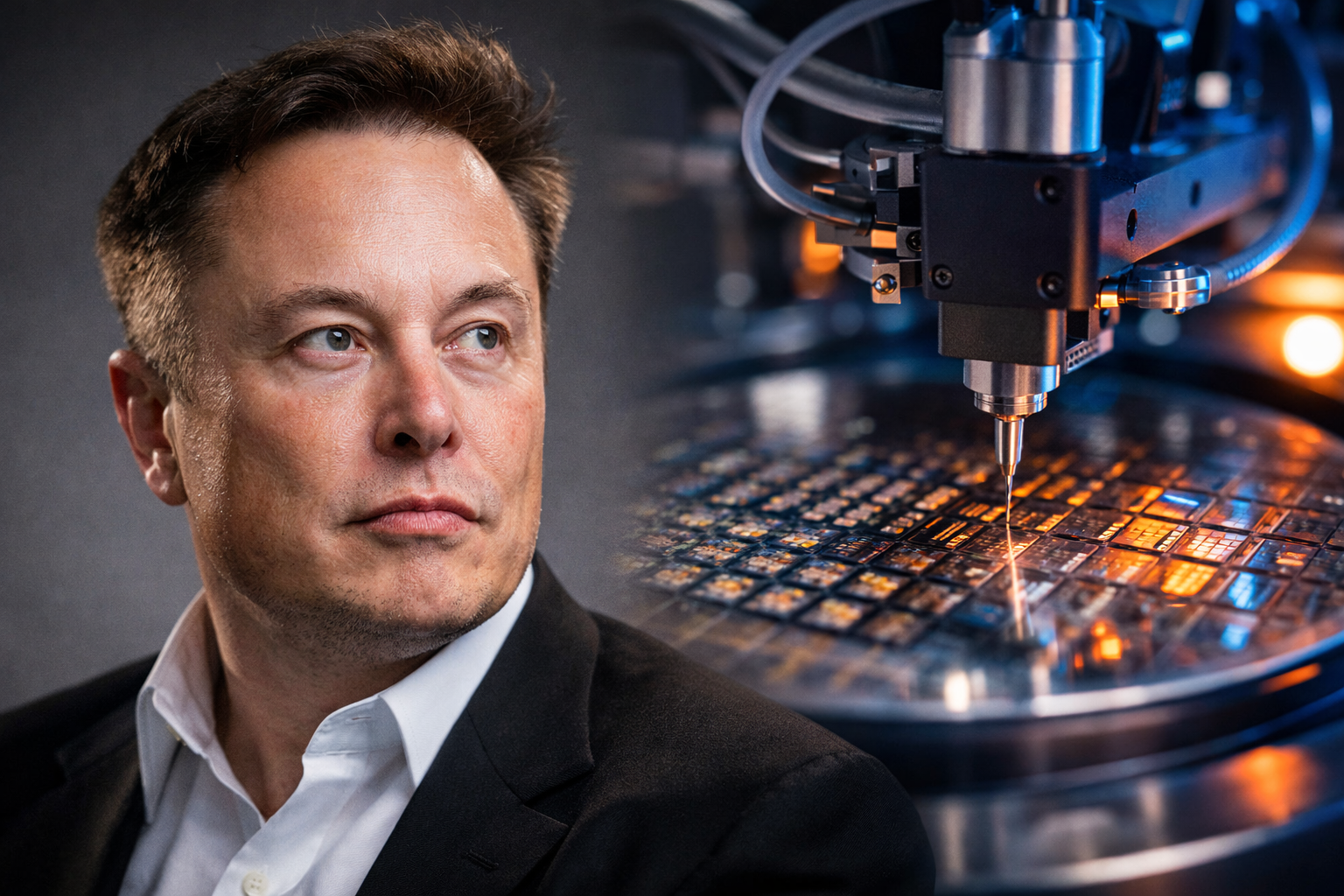
Image Credit: MemoryErasure (Conceptual Illustration)