Let’s Decode the Project
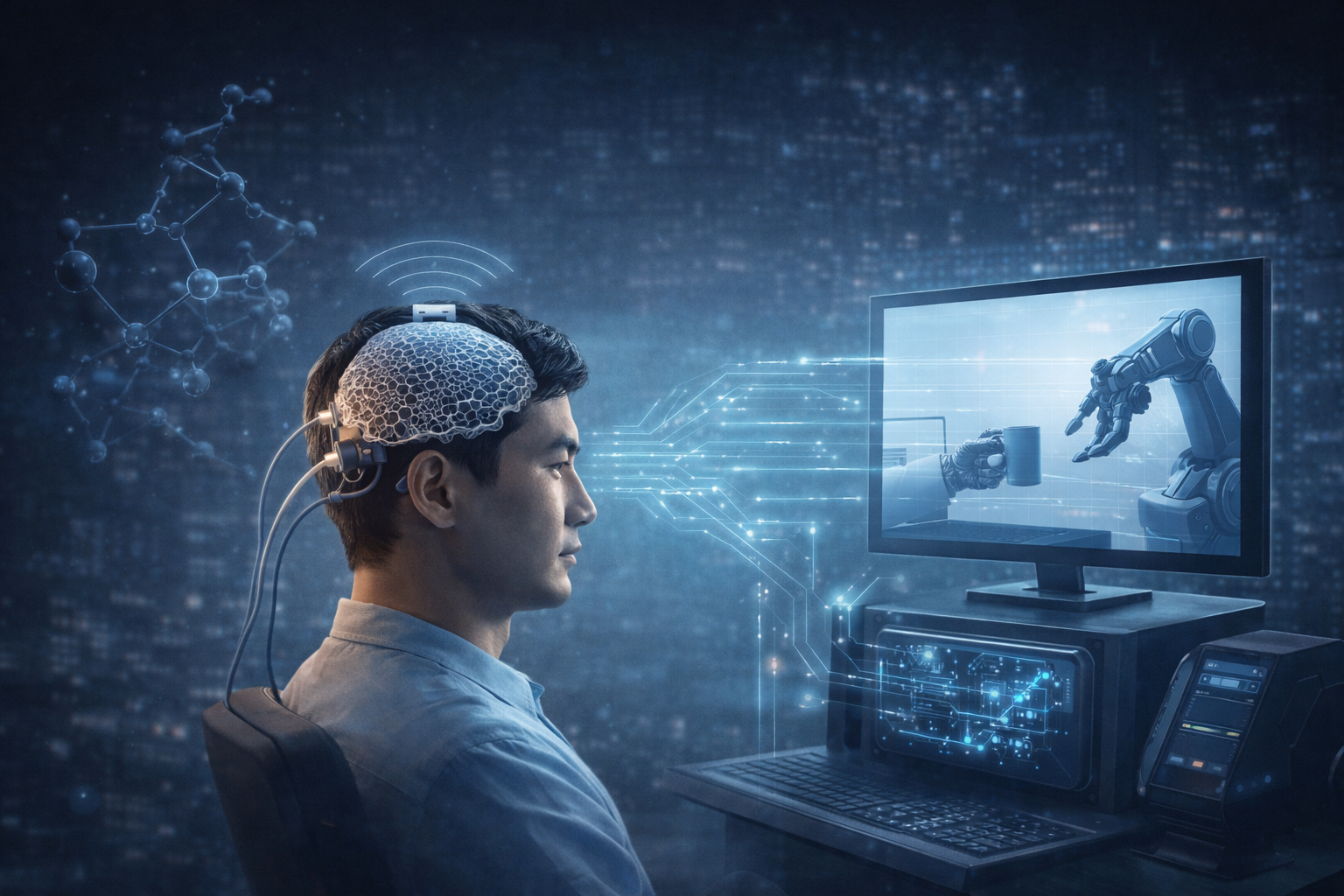
Most brain–AI projects live in the realm of speculation. Beinao‑1 does not. It is a coin‑sized wireless brain chip already tested in Chinese hospitals, enabling paralyzed patients to generate speech and control devices through thought.
Beinao‑1 is China’s attempt to anchor human–AI integration in clinical reality, positioning neurotechnology as both a medical breakthrough and a strategic frontier.
The Scale: From Prototype to Clinical Pathway
Origin: Developed by Beijing neurotech teams with state backing.
Scope: From single‑patient trials to structured hospital deployments.
Ambition: Establish China as a leader in brain–AI interfaces, rivaling U.S. initiatives like Neuralink.
Unlike speculative ventures, Beinao‑1 is already in motion.
Engineering Architecture: Designed for Deployment
Beinao‑1 reflects a deliberate engineering choice: prioritize stability and safety over extreme performance.
Semi‑Invasive Neural Interface
Electrodes placed on the brain’s surface, not deep tissue.
Reduces surgical risk, limits long‑term damage.
Trade‑off: lower signal resolution.
Wireless Signal Transmission
Coin‑sized module eliminates external wires.
Enables patient mobility and cleaner clinical integration.
AI‑Based Signal Decoding
Machine learning models interpret neural patterns.
Converts signals into cursor movement, robotic control, or speech.
Requires continuous calibration.
External System Integration
Interfaces with computers, assistive devices, and robotics.
Creates a closed‑loop system optimized for real‑world use.
Applications: Beyond Medicine
Medical: Restoring communication for paralysis patients.
Industrial: Thought‑driven control of machines and robotics.
Defense: Potential augmentation for military systems.
Education: AI‑assisted cognition for accelerated learning.
Strategic Layer: China’s Cognitive Infrastructure
Beinao‑1 is not just a medical device. It is part of China’s broader push to:
Develop sovereign neurotechnology ecosystems.
Integrate AI with biological interfaces.
Treat cognition augmentation as a national strategic asset.
This positions Beinao‑1 within the category of cognitive infrastructure — systems that redefine how humans interact with machines.
Timeline
2025–2026: Clinical trials with multiple patients in Beijing hospitals.
2027: Expansion into multi‑patient networks.
2028+: Integration with AI systems for collective cognition augmentation.
Challenges & Risks
Signal Fidelity: Surface electrodes limit precision.
Long‑Term Stability: Implants must function reliably for years.
Data Interpretation: AI models require constant refinement.
Scaling: Moving from dozens to millions of users.
Ethical Boundaries: Neural privacy, consent, and data ownership.
Conclusion
Beinao‑1 is best understood as a quiet but decisive step in human–AI integration. It does not chase extremes. It asks a more grounded question: How reliably can we connect the brain to machines?
If successful, it could redefine:
How humans communicate (thought‑to‑speech).
Where intelligence resides (brains linked to AI).
Who controls cognition infrastructure (nations vs private ecosystems).
If it fails, it will still mark China’s boldest attempt to engineer thought into AI systems.
References (Authoritative Sources)
Beijing neurotech clinical trial reports (2025–2026)
Nature Neuroscience — wireless brain–computer interface studies
Chinese Academy of Sciences — neurotech strategy papers
MIT Tech Review — comparative analysis of Neuralink vs Beinao‑1
Global neurotech investment outlook (Barclays, Mizuho)
Image Credit: MemoryErasure (Conceptual Illustration)