Artificial intelligence continues to reshape robotics, but some of the most promising breakthroughs are not about brute computational power—they are about learning from nature. This week, researchers at Worcester Polytechnic Institute (WPI) announced a striking advance: bat‑inspired aerial robots that use ultrasound sensors and AI algorithms to navigate in conditions where human rescuers and conventional drones struggle. Published in Science Robotics on March 25, 2026, the study demonstrates how bioinspired design can save lives in disaster zones filled with smoke, fog, or dust.
The Breakthrough
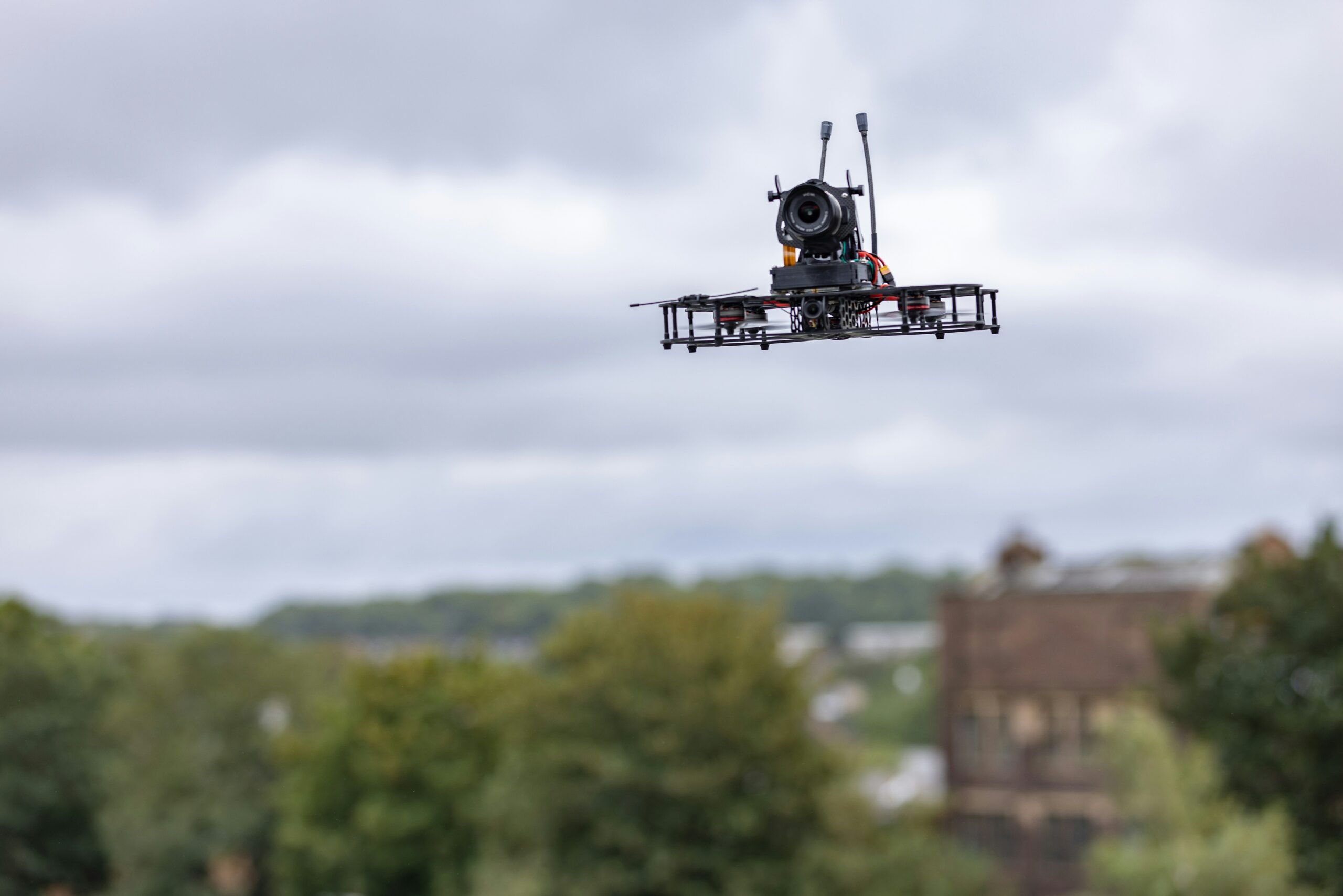
The WPI team, led by Assistant Professor Nitin J. Sanket, developed palm‑sized robots that mimic bats’ echolocation abilities. Bats weighing less than two paper clips can fly through dark caves by emitting chirps and interpreting faint echoes. Translating this biological marvel into robotics, the researchers equipped drones with ultrasound sensors and trained AI models to process the signals in real time.
Unlike LiDAR or radar systems, which are heavy and power‑hungry, ultrasound sensors are lightweight, inexpensive, and energy‑efficient. This makes them ideal for small drones that need to operate for extended periods without bulky batteries.
Source: Tech Xplore – Bat‑Inspired Ultrasound Helps Palm‑Sized Drones Navigate Fog and Smoke
Why It Matters
The implications of this breakthrough are profound:
Search & Rescue: In collapsed buildings or smoky disaster zones, visibility is often near zero. Robots that can “see” with sound could locate survivors faster and more safely than human teams.
Military Reconnaissance: Navigating obscured terrains without GPS or cameras could give defense forces new tactical options.
Commercial Drones: Delivery and inspection drones often fail in poor weather. Ultrasound navigation could make them more reliable.
Technical Details
The robots are palm‑sized aerial vehicles equipped with arrays of ultrasound sensors. AI algorithms interpret the echoes to build a map of the environment, allowing the drones to avoid obstacles and maintain stable flight.
Key features include:
Low power consumption compared to LiDAR.
Real‑time AI processing of ultrasound signals.
Scalability, since ultrasound sensors are cheap and widely available.
Robustness, enabling navigation in visually degraded environments.
The team tested the robots in simulated disaster conditions, including smoke‑filled chambers and foggy environments. Results showed consistent navigation performance, even when cameras and GPS failed.
Expert Commentary
“Bats that weigh less than two paper clips can accurately navigate in dark, damp, and dusty caves by sending out short chirps and listening to weak echoes,” Sanket explained. “We’ve shown that ultrasound combined with AI can replicate this ability in machines.”
This statement underscores the bioinspired philosophy driving modern robotics: rather than reinventing navigation systems from scratch, engineers are learning from millions of years of evolutionary optimization.
Broader Context in AI Robotics
This breakthrough is part of a larger trend in AI robotics: bioinspired design. From robotic fish that swim like tuna to quadrupeds that mimic cheetahs, engineers are increasingly turning to nature for solutions.
The WPI study stands out because it addresses a critical gap in disaster response. Traditional drones rely heavily on cameras, GPS, or LiDAR—all of which fail in degraded environments. By shifting to ultrasound and AI, the researchers have opened a new frontier in resilient robotics.
Source: Scienmag – Bats Propel Breakthroughs in Aerial Robotics (scienmag.com)
Potential Applications
Disaster Response
Locating survivors in collapsed buildings.
Navigating smoke‑filled environments after fires.
Operating in dust storms or foggy conditions.
Military & Security
Reconnaissance in visually degraded battlefields.
Surveillance in tunnels or caves.
Commercial Use
Package delivery in poor weather.
Infrastructure inspection in foggy or dusty sites.
Challenges Ahead
Despite the promise, challenges remain:
Scaling up: Palm‑sized robots are effective in controlled environments, but scaling to larger drones may require more complex sensor arrays.
Signal interference: Ultrasound can be disrupted by environmental noise.
Regulatory hurdles: Deploying autonomous drones in disaster zones requires strict safety protocols.
Conclusion
The WPI breakthrough demonstrates how AI and bioinspired design can converge to solve real‑world problems. By mimicking bats’ echolocation, researchers have created robots that can operate where humans and machines often fail.
As disasters become more frequent due to climate change, and as urban environments grow more complex, innovations like these could save countless lives. The next step will be moving from laboratory prototypes to field‑ready systems, tested in real emergencies.
Image credit: Unsplash