Let’s Decode the Project
Purpose of Artemis II
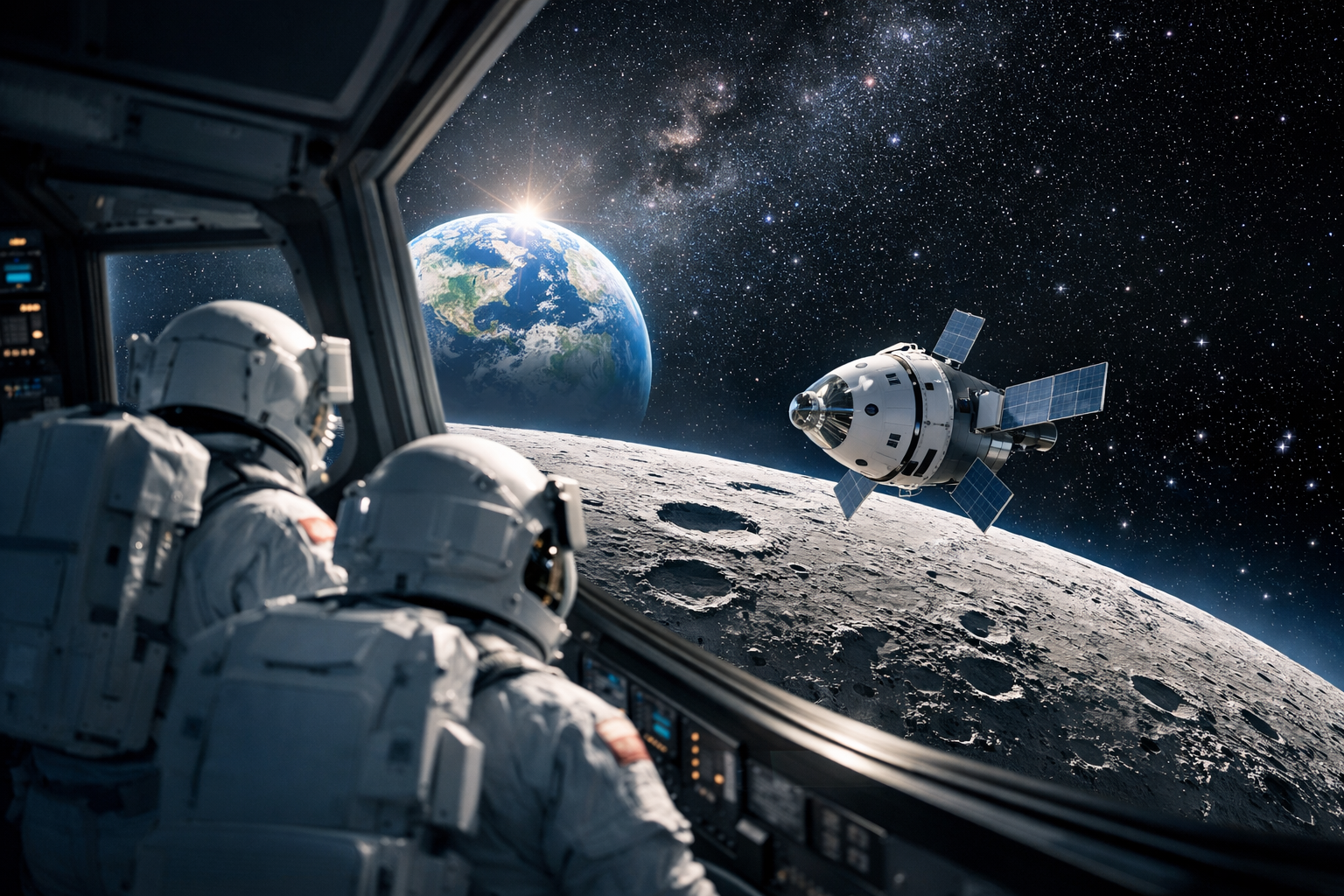
NASA’s Artemis program is structured in stages. Artemis I proved the rocket and spacecraft could fly. Artemis II now puts humans inside the system, orbiting the Moon to validate life‑support, navigation, and communication.
The purpose is clear:
Safety first: Before landing on the Moon, NASA must ensure astronauts can survive the journey.
System rehearsal: Every maneuver, from docking to re‑entry, is a practice run for future missions.
Gateway to Mars: Artemis II is the bridge between Apollo’s legacy and humanity’s next frontier — Mars.
Human Impact
Scientific Expansion
The Moon is more than rock and dust. It is a time capsule of the solar system’s history. By preparing for sustained lunar missions, Artemis II lays the groundwork for discoveries that could reshape our understanding of Earth’s origins.
Technological Innovation
Space missions are laboratories for invention. The systems tested on Artemis II — advanced materials, medical monitoring, sustainable energy — will eventually filter into everyday life. Just as Apollo gave us satellite communications and miniaturized electronics, Artemis II could spark breakthroughs in healthcare, energy, and AI‑driven navigation.
Global Collaboration
Artemis is not just NASA’s project. It involves international partners from Europe, Japan, and Canada. This mission signals a new era of shared human exploration, where nations cooperate not for conquest but for collective progress.
Cultural Meaning
Artemis II rekindles the human dream of exploration. It reminds us that space travel is not only about science, but about courage, curiosity, and identity. For a generation that has never seen humans leave Earth’s orbit, this mission is a cultural milestone.
Expected Outcomes
Safety Certification
Prove Orion’s environmental control and life‑support systems can sustain astronauts for long‑duration missions.
Validate re‑entry heat shield performance at lunar‑return speeds.
Operational Readiness
Test navigation, docking, and trajectory correction burns in deep space.
Ensure communication systems remain stable beyond Earth orbit.
Crew Experience
Train astronauts in real lunar mission conditions.
Build confidence for Artemis III, which will attempt the first lunar landing since Apollo.
Strategic Impact
Establish the Moon as a gateway to Mars.
Strengthen international partnerships (Canada, Europe, Japan) in shared exploration.
Editorial Perspective
The purpose of Artemis II is not simply to orbit the Moon. It is to prove that humanity can live, work, and thrive beyond Earth. Every system tested, every maneuver rehearsed, is part of a larger vision: a permanent human presence in space.
This mission is about trust — trust in technology, trust in international cooperation, and trust in humanity’s ability to adapt. If successful, Artemis II will mark the beginning of a new era where the Moon is not a destination, but a base camp for the stars.
The Human Story Behind the Mission
Artemis II is a reminder that exploration is not about distance, but about direction. The astronauts aboard are not just travelers; they are pioneers of purpose. Their journey is symbolic of humanity’s collective will to push boundaries.
The mission tells us:
We are not confined to Earth.
We are capable of building beyond our home planet.
Our future is not limited by gravity, but by imagination.
What Comes After Artemis II
Artemis III: The first lunar landing in decades, with astronauts walking on the Moon again.
Lunar Base: Plans for a permanent station on the Moon’s surface, enabling long‑term science and resource use.
Mars Preparation: Lessons from Artemis will directly inform human missions to Mars.
Conclusion
Artemis II is humanity’s rehearsal for the future. Its purpose is to ensure that when we return to the Moon, we do so not as visitors, but as settlers. The mission is a reminder that exploration is not about distance — it’s about direction. And the direction is clear: outward, toward a shared human destiny among the planets.
Sources
Image Credit: MemoryErasure (Conceptual Illustration)