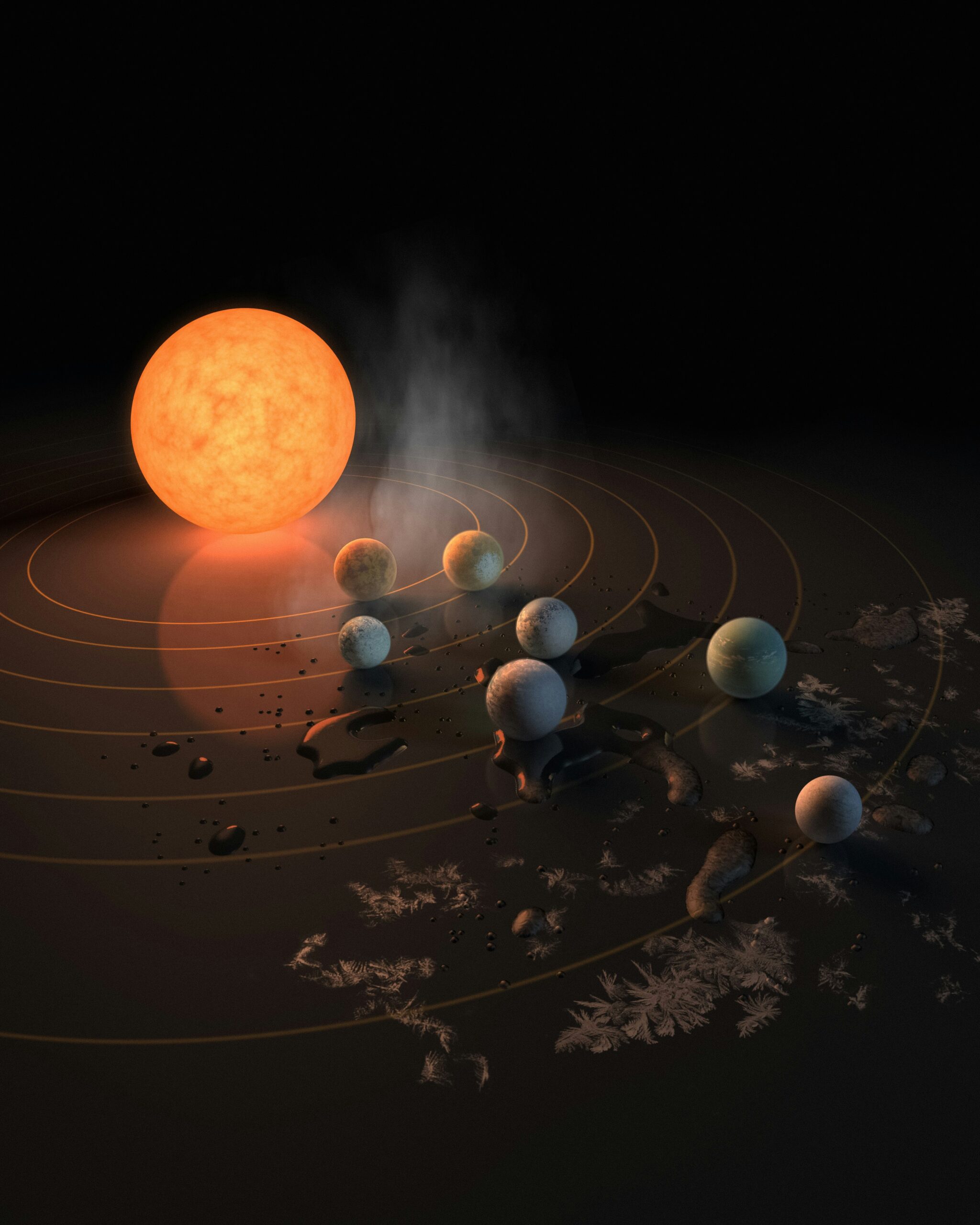
When planetary science felt predictable
For decades, planetary science was built on the Solar System as its guiding template. The inner rocky planets, the outer gas giants, and the relatively circular, coplanar orbits seemed to offer a neat and orderly framework. This structure shaped models of planet formation and evolution, and it gave scientists confidence that the rules they had derived from our own system would apply broadly across the galaxy.
What astronomers expected to find
When astronomers began searching for planets around other stars, they expected to uncover familiar architectures. The assumption was that other systems would host small terrestrial planets near their stars, gas giants farther out, and orbital patterns that echoed our own. Theories emphasized slow accretion within protoplanetary disks, modest migration, and relatively stable dynamical histories. In short, the Solar System was thought to be typical.
The growing list of planets that don’t fit the rules
Instead, surveys revealed a startling diversity. Hot Jupiters—gas giants orbiting their stars in just a few days—were among the first surprises. Soon came super‑Earths, planets larger than Earth but smaller than Neptune, which are abundant elsewhere yet absent in our system. Ultra‑short‑period planets, eccentric orbits, and systems with misaligned spins added to the list. These discoveries are not rare anomalies; they are common outcomes, suggesting that the Solar System may be unusual rather than representative.
Why current models are struggling to explain them
The challenge is not that physics has failed, but that models built on limited assumptions are incomplete. Classical frameworks often assumed smooth disks, slow migration, and orderly growth. The observed diversity points to more complex processes: rapid migration, strong planet–planet scattering, variable disk chemistry, and environmental influences from stellar companions. Observational limits on disk turbulence and early stellar activity leave room for competing explanations. Models must now account for a wider range of initial conditions and evolutionary pathways.
What scientists are carefully rethinking
Researchers are moving toward ensemble approaches, where models predict distributions of planetary properties rather than single outcomes. Pebble accretion, disk‑driven migration, and late dynamical rearrangements are being integrated into unified frameworks. The emphasis is on connecting observations of young disks with mature planetary systems, and on building probabilistic models that reflect the diversity revealed by surveys. This is a refinement of planetary physics, not a rejection of it.
Why these discoveries matter beyond astronomy
Understanding planetary diversity has implications far beyond astrophysics. It informs how we model planetary interiors and atmospheres, how we assess habitability potential, and how we prioritize targets for telescopes and missions. It also strengthens interdisciplinary links between observational astronomy, laboratory experiments on material properties, and theoretical physics. The recalibration of planetary models is shaping how science organizes its search for worlds and how it interprets their signals.
What strange exoplanets do not mean
The presence of unusual exoplanets does not imply that fundamental physics is broken or that exotic new forces are at play. Instead, they highlight the variety of initial conditions and evolutionary histories that planetary systems can experience. Scientific restraint is essential: these discoveries expand the parameter space, but robust inference requires larger samples and careful attention to observational biases.
humility, curiosity, calm discovery
“Humility, curiosity, and a calm sense of discovery are what the exoplanet record invites.” The exoplanet revolution invites humility. The universe is more complex than our first models suggested, and the Solar System may be less typical than once assumed. By combining careful observation, disciplined modeling, and patient interpretation, scientists are mapping the true diversity of planetary systems. This process is not about overturning physics but about refining our understanding. It is a calm, curiosity‑driven journey into a richer cosmos.
References & further reading
- NASA Exoplanet Archive — https://exoplanetarchive.ipac.caltech.edu (exoplanetarchive.ipac.caltech.edu in Bing)
- Nature Astronomy — https://www.nature.com/natastron
- European Southern Observatory (ESO) — https://www.eso.org/public/science/exoplanets (eso.org in Bing)
- ISRO — https://www.isro.gov.in (search “exoplanet” for current projects)
- Astrophysical Journal (ApJ) — https://iopscience.iop.org/journal/0004-637X
Image credit: Unsplash